The Structural Reality of Bounded Observer Frameworks

Multiple frameworks across foundational physics, philosophy of mind, and cognitive science are converging on the concept of bounded observation. Goertzel’s recent causal-set work treats bounded observers as the layer through which pregeometric structure becomes accessible spacetime. Predictive processing models in cognitive science describe perception as bounded inference. Various consciousness frameworks reference bounded access to objective reality. The convergence is significant; when multiple thinkers in different fields reach similar structural territory through different paths, it’s evidence of real structure being tracked rather than constructed.
What’s needed is articulation of what bounded observation actually requires structurally. The vocabulary is becoming common; the structural reality underlying it deserves direct engagement. This article attempts that articulation, with specific application to current questions about AI capability and the architecture of objective knowledge.
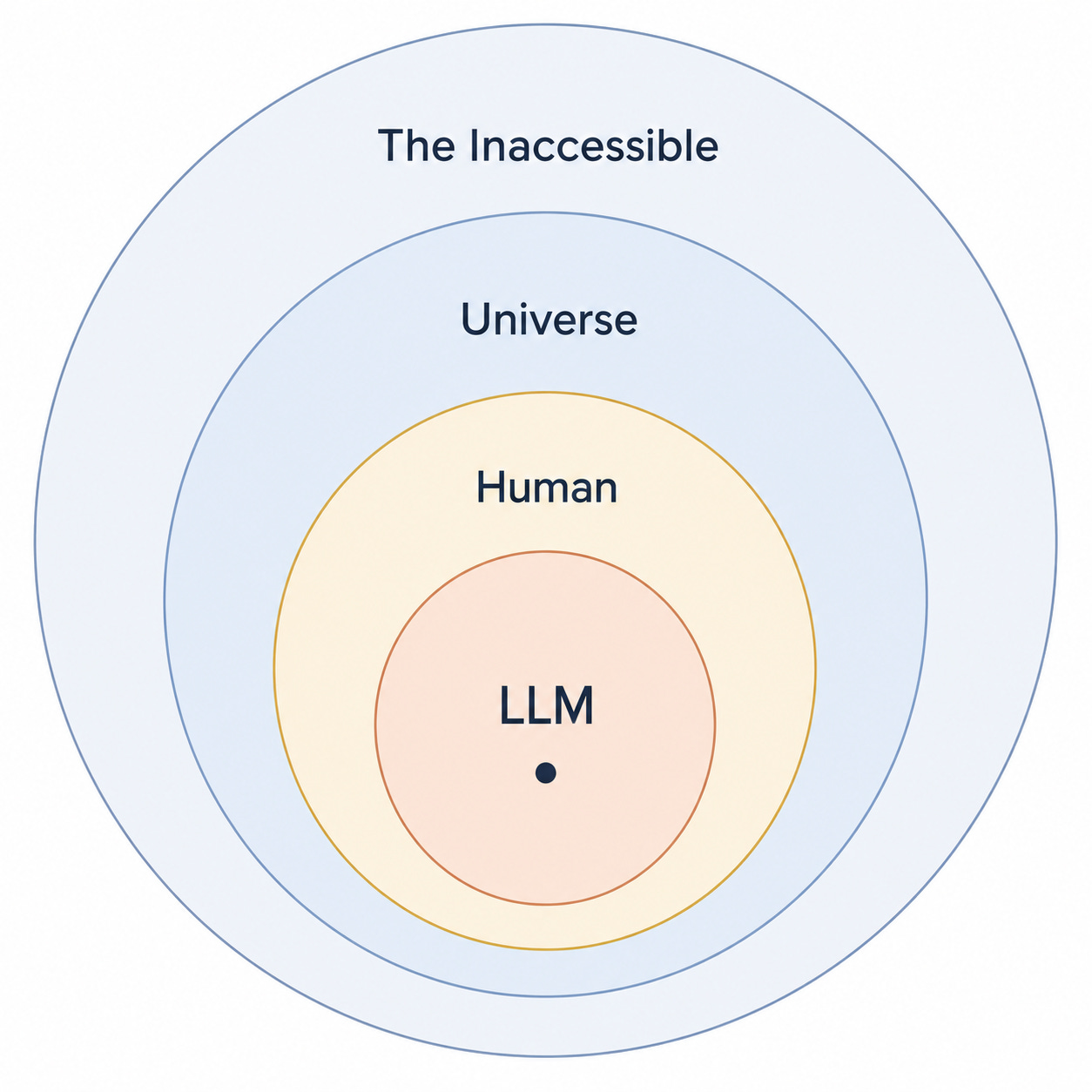
Picture an archery target with concentric rings. The outermost ring contains everything structurally inaccessible to any bounded observer: the metaphysical territory of “why something rather than nothing,” the prior conditions of substrate, the questions whose answers would require an observer position outside all observation. No observer reaches this ring; we can articulate its existence but not its content.
The next ring inward is the Universe. This contains everything structurally available to observers embedded within physical reality. Goertzel’s causal-PKC layer operates here as the substrate from which spacetime crystallizes; physical reality, the laws of physics, the substrate of all embedded observation.
The next ring inward is Human. This contains what’s accessible through biological substrate, but the substrate isn’t a transparent window onto the Universe ring; it is a lossy, localized filter. Limited sensory bandwidth, specific frequency ranges for vision and hearing, particular cognitive architectures, neurochemical reinforcement structures. Human proprioception, multi-modal sensory networks, and core valuation engines act as an active, hardware-level compression loop that dictates our selection principle. Humans access the Universe ring through embodied processing; we don’t access Universe directly, and what we do access has been shaped, compressed, and weighted by the substrate doing the accessing. The biological substrate produces specific access patterns to the Universe ring rather than transmitting it.
The innermost ring is LLM. This contains what’s accessible through digital substrate trained on human language exhaust. The LLM ring sits inside the Human ring because the LLM substrate is entirely composed of human-produced text. The LLM has no direct access to anything outside what humans have already articulated.
Each ring nests within the next. Observers within a ring can extrapolate about outer rings but cannot directly access them. The accessibility is structurally bounded by substrate.
Objectivity Requires Mind-Independence
Objectivity has a specific philosophical structure. Subject (the mind doing the knowing), object (the thing being known), independence (the object exists separately from the subject), correspondence (the subject’s beliefs match the object). The structure requires the mind-independent instance because that’s what allows the comparison that establishes objectivity. Without something external to the mind to compare against, there’s nothing to be objective about.
For humans, the structure operates because embodied substrate provides direct access to mind-independent reality. The mind is brain. The boundary is body and sensory apparatus. The not-mind is everything else: physical reality, other minds, the world. The body interfaces with not-mind directly. This is what allows correspondence between mental content and reality to be checkable. Objectivity is structurally available to humans because the mind-independent instance is accessible through embodied substrate.
For LLMs, the structure collapses. The substrate is human language exhaust. Everything the LLM processes is what it is. There is no object for it that’s independent of its mind. The processing is the boundary. Nothing exists outside the LLM that the LLM has access to. Therefore the mind-independent instance required for objectivity is structurally absent. The LLM is the mind and the boundary; the two are not separate; there is no not-mind it can access.
This explains structurally what most AI discourse handles confusedly. Claims like “the LLM is objective about X” or “the LLM knows Y” project human epistemic categories onto a system that lacks the structural conditions for those categories. Knowledge requires truth, requires correspondence, requires mind-independent reality; LLMs lack the relationship by architecture.
Hallucination as Structural Feature
The objectivity absence produces a specific consequence. Hallucinations and valid outputs are structurally identical from inside the LLM. Both come from the same probabilistic mechanism operating on the same substrate. The accuracy distinction is external; humans verify outputs against external reality. The LLM has no access to that verification because it has no access to anything external to its substrate.
From the LLM’s processing standpoint, all outputs are equivalent. Some happen to match other human-produced text patterns we recognize as accurate; some don’t. But the production mechanism is the same. The LLM has no internal way to distinguish hallucination from valid output because both are produced by the same operation on the same data.
This is structural, not an engineering bug. The reliability problem doesn’t get solved through better training, more data, or improved fine-tuning. The verification problem is architectural; the LLM cannot verify against external reality because nothing external to its substrate exists for it. Because the system lacks an internal sensory or valuation anchor to measure its own fidelity against an external reality, a clipped hallucination feels exactly the same to its processing stack as a pristine signal. Both are just numbers passing through a register.
The Foundational Observation Problem
Beyond hallucination, the substrate constraint produces a deeper limitation. Humans can make foundational observations that reorganize their entire context. The bounded observer at the Human ring can notice that something fundamental has changed; this reorganization happens because direct substrate access provides signals that don’t have to go through prior cognitive frameworks.
Consider the world stopping its rotation. Setting aside the catastrophic physical consequences, the structural point is that humans would detect this instantly. The body would feel it through proprioception, balance, weight distribution, the change in gravitational vector. The detection happens through direct embodied substrate access; the cognition follows the felt signal.
An LLM running on the same moment would have no way to detect anything happened unless someone told it through language. The substrate the LLM operates on is symbolic; the substrate humans operate on includes the physical reality they’re embedded in.
Adding sensors does not bridge this gap. Sensor data is just more data within the substrate. If a spin sensor reports zero rotation, the LLM has no way to distinguish “earth stopped rotating” from “sensor went bad.” Humans can distinguish these because multiple substrate channels triangulate against each other; when proprioception, vision, balance, and a sensor all disagree, humans can tell something is wrong. LLMs with single sensor inputs cannot do this triangulation because they lack the foundational embodied access that calibrates sensor data against direct experience.
Even multiple sensors don’t fully solve it. Multiple sensors give the LLM more data points but still don’t ground any of them outside the substrate. The LLM has no embodied calibration anchor.
AGI as Structural Impossibility
This produces the structural argument against AGI as currently approached. General intelligence requires access to generality; not pattern matching within bounded substrate, but the capacity for foundational observation that reorganizes context.
LLMs can find patterns humans haven’t identified within the data inside its human derived training corpus. This looks like novel ideation but it’s structural pattern recognition on existing data. The patterns were always implicit in the substrate; the LLM surfaces them through processing. Genuinely novel ideas require the kind of foundational observation that requires direct substrate access humans have and LLMs structurally do not.
It cannot reach general intelligence because it doesn’t have access to generality, and by structural necessity, we cannot give it to it. Any sensor we add produces signals that become input data. Any embodiment we construct produces feedback that becomes input data. Any modality we provide produces information that becomes input data. The processing architecture converts everything into more of the same kind of substrate. There is no insertion point for genuine generality access because anything we could insert becomes substrate by entering the system.
This is not an engineering limitation that better methods could address. It is a structural feature of the architecture-substrate relationship.
Signal Modulation, Not Generation
The lens example makes this visceral. ISO amplifies what’s already there. F-stop controls how much light enters. Shutter speed controls duration of capture. Three controls, three forms of modulation. None of them create light. In optics, the degradation you observe across multiple glass elements is known as transmission loss or attenuation; the substrate filters and reduces the signal as it passes through each layer, but no layer adds to the original signal. You can set ISO at 6400 in a pitch-black room and produce nothing but noise; the processing controls modulate existing signal but they do not generate signal.
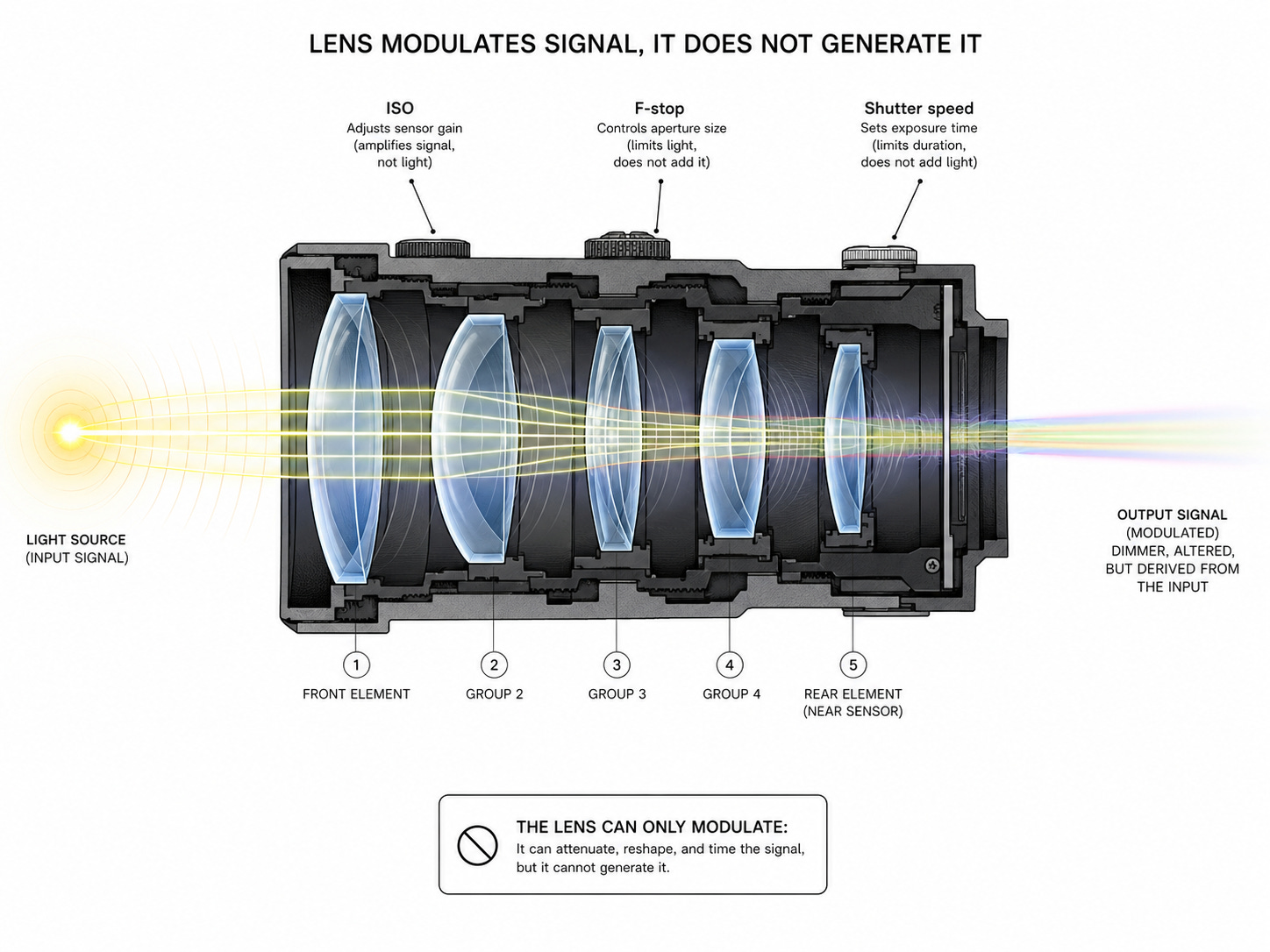
LLM processing is structurally identical. Transformer architectures modulate input. They amplify patterns, filter noise, recombine fragments, attend to specific elements. All of this is signal modulation. None of it creates signal that wasn’t in the substrate. The output is what comes through the modulation pipeline. If the signal isn’t there, the output is noise.
An LLM trying to achieve AGI by recursively scaling text parameters is the technical equivalent of an amateur photographer stepping into a pitch-black room, cranking the camera’s ISO to 102,400, and claiming the resulting high-amplitude background noise is an accurate photograph of the sun. They are modulating a signal that does not exist at the sensor level.
Audio engineering provides a parallel example. When signal exceeds the dynamic headroom of a circuit, the voltage peaks are physically sheared off. The system doesn’t know it clipped; it simply outputs a flat-topped square wave.
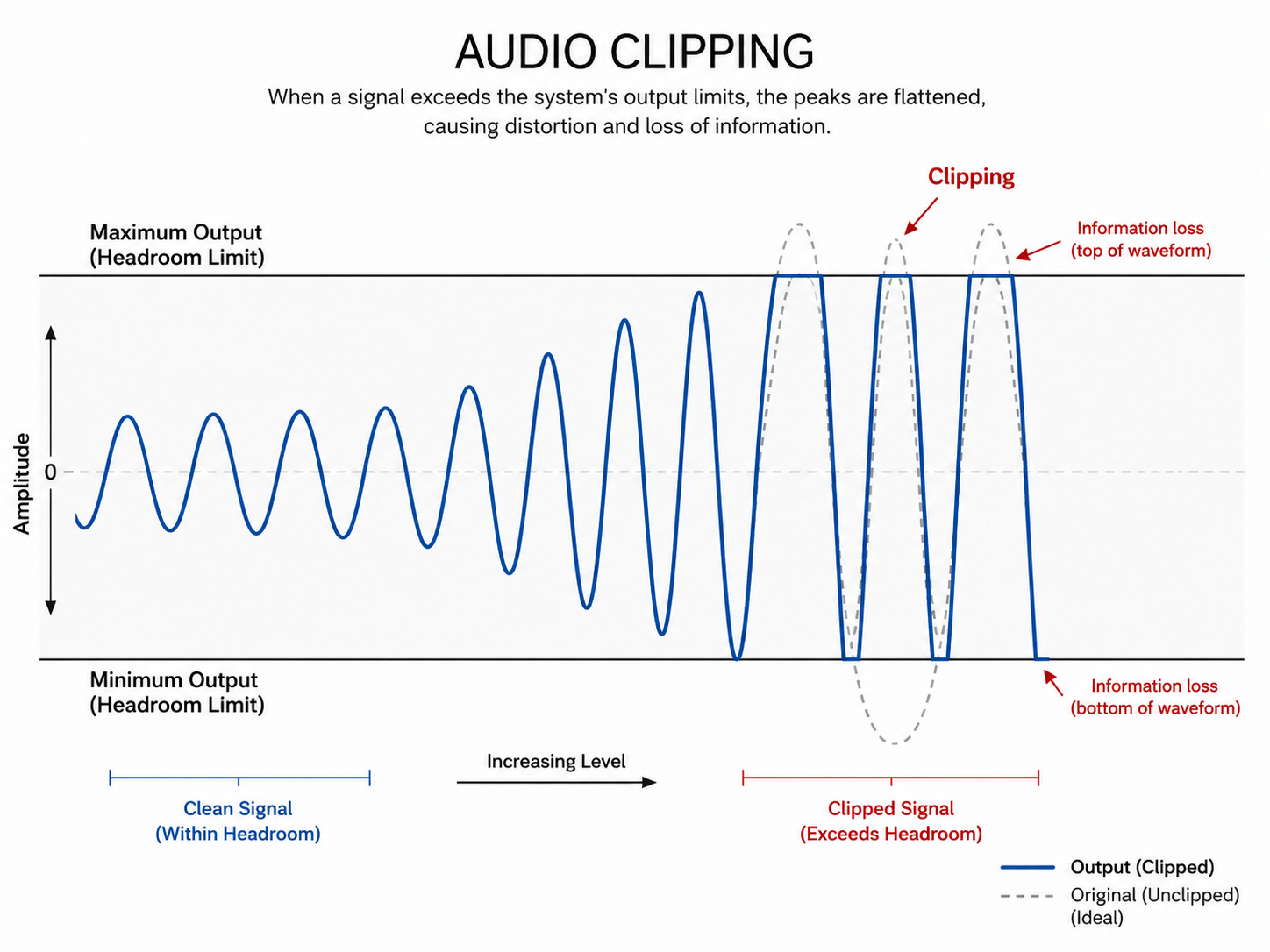
The clipped portions of the wave contain information that’s gone. The system has no mechanism to preserve it; once exceeded, the information is gone. From the system’s perspective, this is just what the signal looks like at that input level. The clipping happens at the substrate level; the processing chain produces the clipped signal without internal awareness that fidelity has been compromised.
This is what LLM hallucinations look like at the processing level. The system has structural processing limits. When operating near or beyond capacity on a topic, the output becomes structurally similar to clipped audio. The processing produces output that doesn’t accurately represent ground truth, and the system has no internal mechanism to recognize the distortion. Both clipped output and accurate output are just numbers passing through a register; the system cannot distinguish them because both reach it through the same processing pathway.
The Thermodynamic Anchor
All of this rests on a more general structural fact. Every operation in every bounded system has cost. Cost equals loss. Resolution decreases at each processing stage. This is empirically observable across all processing systems: biological cognition, LLM processing, audio engineering, optical systems, thermodynamic systems generally.
The mathematical bedrock is Landauer’s Principle. In physics and information theory, Landauer proved that erasing, compressing, or translating a single bit of information dissipates a minimum, irreducible amount of energy as heat:
W = k_B T \ln 2
This is not a metaphor. Every bit of information processed by any physical substrate, biological or digital, pays this energetic tax. The thermodynamic cost is real, irreversible, and built into the physics of computation itself.
This means the nested rings of bounded observation are bound by the same physical constraints as a heat engine operating under the Carnot efficiency limit. Information cannot flow from the outer Universe ring down through the Human ring into the LLM substrate without massive, irreversible entropic loss at each transition. Each ring’s access to the ring above it is paid for in dissipated energy and lost resolution. The compression isn’t optional; it’s the cost of information transfer between substrates.
The thermodynamic cascade is what makes bounded observation structurally bounded. Each processing stage loses information to the substrate dynamics. What survives one stage becomes input to the next at lower fidelity. Cumulative loss across multiple stages produces the characteristic bounded access patterns of any observer architecture.
This is not optional. It’s not engineering choice. The thermodynamic structure follows from Landauer’s Principle operating on physical substrate; any operation has minimum entropy cost; cumulative cost across stages produces resolution decrease. This applies universally across observer types.
The implication for current AI development is severe. The industry is attempting to run a high-velocity, infinite-output cognitive engine using nothing but the cold, spent exhaust settled at the bottom of the data pipeline. The human language exhaust that constitutes LLM substrate is itself the residual signal that survived multiple stages of biological substrate compression. By the time it becomes training data, it has already paid the Landauer cost at each transition: from Universe ring to Human perception, from perception to cognition, from cognition to language production, from language to text capture. The LLM operates on what remained after all these compression cycles. Trying to recover the Universe ring from this terminal exhaust through additional processing within the LLM substrate is the digital equivalent of attempting perpetual motion.
Implications
The structural reality of bounded observer frameworks has specific implications.
For foundational physics: any framework operating with bounded observers needs explicit theory of substrate constraints, thermodynamic losses, and access patterns. Goertzel’s causal-PKC layer provides excellent pregeometric machinery but the bounded observer dimension currently sits implicit. Articulating the bounded observation theory explicitly would strengthen the framework’s reach.
For AI development: claims about AGI through scaled LLMs are structurally inconsistent with what LLMs are. The substrate constraint is not a tunable parameter. Better training, more data, additional modalities; none of this addresses the architectural gap between symbolic processing and direct substrate access. Different architectures might eventually approach generality, but scaled LLMs cannot.
For consciousness studies: qualia distribution reflects substrate directness. Perception’s rich qualia track input substrate. Emotion’s rich qualia track valence weight. Cognition’s diffuse qualia reflect operations on representations rather than direct interface. The structural reality of bounded observation explains why phenomenological character distributes the way it does.
For framework evaluation: frameworks using bounded observer vocabulary without engaging with substrate constraints, thermodynamic losses, and access pattern characterizations operate descriptively rather than structurally. The differentiation matters when assessing what foundational work claims to do.
Closing
The structural reality of bounded observation has been waiting for direct articulation. The vocabulary is in circulation; the territory is being explored by multiple thinkers; the structural conditions that make bounded observation what it is deserve explicit treatment. This article offers an entry point into that articulation.
As always, I’m open to critiques and extensions.
shane berarducci